

Record interest in the European Defence Fund: 612 project proposals for €1 billion in funding
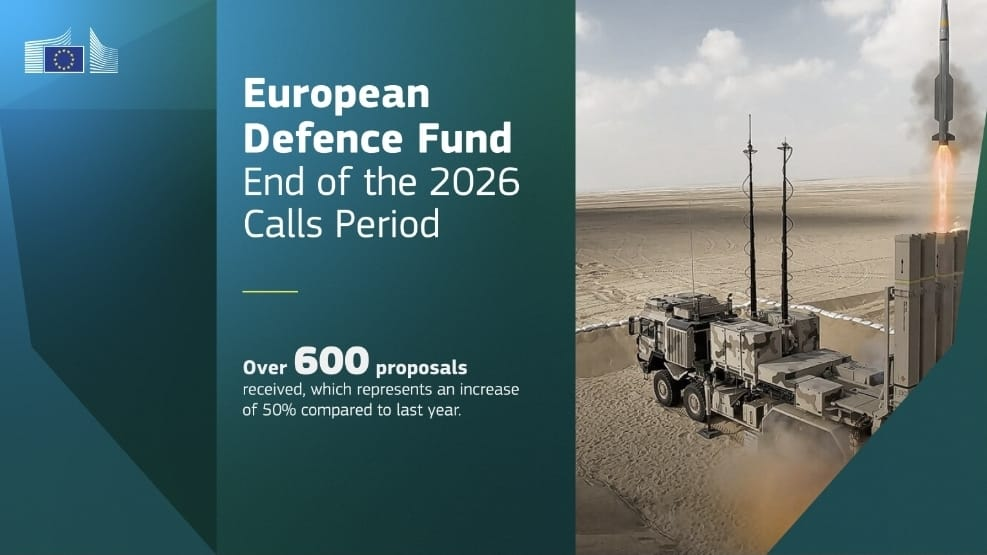
The European Defence Fund (EDF) has recorded a record number of applications under the 2026 call for proposals. A total of 612 project proposals for collaborative defence research and development projects were submitted, marking the highest level of interest in the programme since its launch in 2021.
A budget of €1.006 billion is available for the 2026 call, with the number of proposals received increasing by 49% compared to 2025. This continues the trend of strong growth in interest in the EDF, following a 38% increase in the number of applications in 2025 compared to 2024. The results underscore the growing importance of European funding for the joint development of defence technologies and for fostering cooperation among industry, research institutions, and other relevant stakeholders.
Under the European Defence Fund programme for 2026, open calls remain available, focusing on the development of innovative defence technologies and capabilities. These cover a wide range of areas, including maritime and land platforms, cutting-edge and disruptive defence technologies, electronic components, space technologies, unmanned aerial (UAV) and ground (UGV) systems, as well as the development of advanced defence systems.
These calls offer an opportunity for companies, research institutions, and other relevant stakeholders to participate in European research and development projects, establish international partnerships, and contribute to the development of Europe’s future defence capabilities. Of particular importance is the fostering of links between the industry and the research community, as well as the integration of innovative solutions into European defence value chains.
Development of Advanced Defence Capabilities and Technologies
The 2026 calls under the European Defence Fund (EDF) focus on developing specific next-generation defence technologies and capabilities, with the aim of strengthening the readiness of European armed forces and the competitiveness of the European defence industry.
Half of the available budget is allocated to collaborative research and development activities in key defence capability areas. Priorities include the development of a European endo-atmospheric missile interceptor, a new-generation main battle tank, a multiple-launch rocket system, and a semi-autonomous naval vessel.
Special attention is also given to advanced technologies that will play a crucial role in future defence systems, including quantum-secure communication networks, electronic warfare, cloud computing for multi-domain operations, and high-performance energy systems.
Support for Innovation and Small and Medium-Sized Enterprises
A significant portion of the funding is directed toward the European Defence Innovation Scheme (EUDIS), which fosters the development of disruptive technologies and innovative solutions for defence applications. One-quarter of the total budget is earmarked for EUDIS activities, including approximately €60 million for disruptive technologies.
There has also been strong interest in non-thematic calls—totalling €60 million—aimed at small and medium-sized enterprises (SMEs). This confirms the importance of including smaller, innovative companies in European defence development projects, as well as the potential for simplified application procedures to increase their accessibility.
A new feature of this year’s calls is the eligibility for Ukrainian entities to apply, ahead of the entry into force of an agreement on Ukraine’s association with the European Defence Fund.
Evaluation of project proposals to follow
All submitted project proposals will undergo a detailed evaluation process, involving independent experts. This includes verifying eligibility and compliance with the call’s requirements, assessing scientific excellence, evaluating proposals against award criteria, and conducting an ethical review.
The results of the calls are expected to be announced by March 2027.
The record number of applications underscores the growing significance of the European Defence Fund as a key instrument for developing joint defence capabilities, fostering innovation, and strengthening the European defence industrial base.
Više informacija na linku: